Southside Street is located in the historic port area of the City of Plymouth known as the Barbican, featuring the largest concentration of cobbled streets in Britain, over 100 listed buildings and vibrant independent art galleries, bars and restaurants.
Southside Street gained its name from being situated at the south side of Sutton harbour which was the original medieval port area known as Sutton (South Farm in Saxon) before the town grew into what we know as Plymouth today. Southside Street dates back to the medieval period as a dirt track and was later developed into a busy commercial and residential area during the Elizabethan era as local privateers brought wealth to the port.
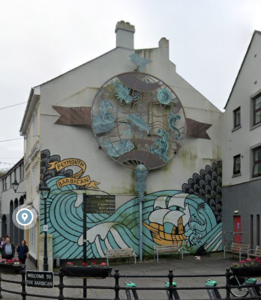
Entering Southside Street from the northern junction with Notte Street the first item of note is the striking mural on the gable end of the building on the right hand side with distinctive ship in crashing waves design and the Leviathan (Plymouth Prawn). The mural was created by the LOCI Collective in 2020 and sits under a sizable sculpture of a globe containing various sea creatures of unknown origin. Both depict Plymouth’s strong links to the sea.
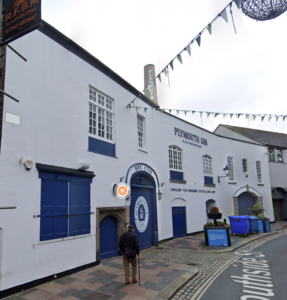
Walking South along Southside Street the first significant buildings are the Plymouth Gin Black Friars Distillery building on the right hand side and associated warehouse buildings at number 5 opposite.
The oldest parts of the distillery building are from the early 1400s when the building was part of a monastery inhabited by the Black Friars. Following abolition of the monasteries under King Henry VIII in 1536 the building was repurposed and for a period served as a debtor’s prison. It is said that the Pilgrim Fathers spent their last night in England in the building in 1620 prior to setting sail on The Mayflower for the new world. The earliest evidence of the building being used for alcohol production is in 1697 when records show a malt house on the premises. In 1793 the site began producing Plymouth Gin and has continued until today making it the oldest working gin distillery in Britain.
Plymouth Gin bottles feature a depiction of The Mayflower ship on their label and Black Friars Distillery moulded into the bottle glass below the label a nod to the heritage of the building.
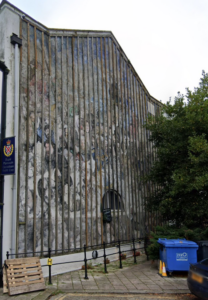
The building opposite at 5 Southside Street was constructed in the mid 19th century and served as the original bottling plant and bonded warehouse for Plymouth Gin. Until the late 20th century it was a common sight to see aged barrels of gin being rolled across the street for bottling and storage in the warehouse which featured special tax provisions for the import and export of goods.
Following the building’s industrial use the first floor of the building was acquired by Robert Lenkiewicz, one of Plymouth’s most famous, influential and eccentric artists. He used the space as his home and art studio. If you walk down the narrow alleyway known as Black Friars Ope to the rear of the building an original Robert Lenkiewicz mural is present, originally completed in July 1972. Unfortunately the work used paints the artist had to hand which are not UV stable and have deteriorated over the years. In the late 1990s the wall was battened with the anticipation of covering the original and having the same art repainted by Lenkiewicz using suitable materials, however the project was never completed prior to Robert’s death on August 5th 2002 aged 60.
After Lenkiwicz’s occupation of the property the vast open space of the ground floor operated as a pannier market for local traders until 2014. In 2016 the building changed hands again and the new owner developed it into its current “The Bottling Plant” restaurant and cocktail bar. The refurbishment project was sympathetic to the building and sought to restore original features such as historic wooden beams, uncovering of the original flagstone floors and re-use of timber panels for building the new bar.
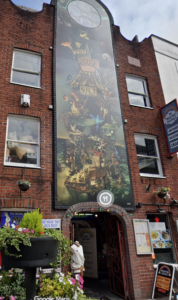
Following the road around the curve heading east the next property of note is the red brick building slightly further along at 10 and 11 Southside Street, known today as The House That Jack Built. The building was originally an 18th century warehouse and later a family-run vegetable and fruit wholesaler. In 1980 Jack Nash remodelled the building over two years, opening in 1982 as a quirky indoor shopping arcade with winding corridors and fantasy design. In 1985 neighbour Robert Lenkiewicz adorned the building with a mural “The Last Judgement” and crafted the iron gates (to hell) across the building’s door. At the time the mural created a lot of controversy due to the depiction of 88 nude figures modelled after recognisable Plymouthians including local doctors, restaurateurs and shop owners. In 2015 the fading mural fell into disrepair and was removed from the building and later replaced in 2022 by the current artwork “Mystical Dawn” by Jack’s son Andy Jack Nash although Lenkiewicz’s gates remain.

Opposite next door to the Wetherspoon’s pub is a more modern post war building (57 Southside Street). The central portion of this building with gated access to the courtyard behind and cobbled stones interrupting the pavement marks the approximate location of the original entrance to The Church of the Holy Trinity, an Anglican church built in 1842 and destroyed in the Plymouth Blitz during the Second World War. Further new developments can be seen from Friars Lane on the site which was previously occupied by the church. One of the properties is used as a holiday let listed online as “The Catacombs” and features of the church can be seen in the photographs of the property including vaulted ceilings and walls of burial chambers from the church in the basement. Furthermore in the developments carpark the original walls of the church are visible including arches and doorways, but these are not accessible to members of the public.
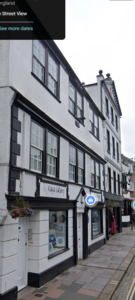
53 Southside Street features a 17th century merchant house which was occupied by John Collier, a local wine merchant. The property is thought to have been re-modelled in the late 18th century as suggested by a dated inscription on lead rainwater head. John Collier held Quaker beliefs and was chosen as an Alderman of the town. During the first election following the Representation of the People Act 1832 he was elected as MP for Plymouth and served until 1841. He was well respected by the people of Plymouth and as a mark of respect flags on Plymouth Guildhall were lowered to half mast during his funeral on 5th March 1849.
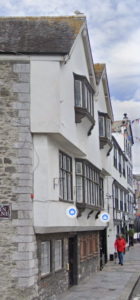
Number 51 Southside Street is a property typical of the area featuring late Elizabethan / early Stuart era features. The ground floor is constructed primarily of Plymouth limestone supporting a plastered, timber framed jettied upper front with twin gabled roof. The property was known to be a merchant’s house dating to the early 17th century, these were typically larger properties which went beyond simply being a home, but also a place where the merchant could conduct his business. This example has clearly had some modernisation over the years, however more historically complete examples may be seen at Merchant’s House (early 16th century) at the junction of Palace Street and St Andrew Street and Prysten House (early 15th century) on Finewell Street. These properties typically had a frontage on a busy street with the ground floor serving as a shop, counting house or trading window where the merchant could negotiate deals and meet with clients, the merchant and his family would live upstairs. Often merchants’ houses would have a rear block separated by a courtyard and gallery where imported goods could be warehoused safely away from the street. Prysten house still retains such a layout.
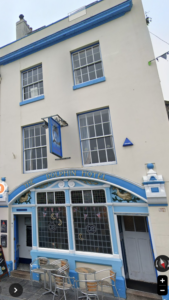
Further along Southside Street the buildings turn more modern dating from the late 18th to early 19th century (Georgian / Victorian). It is thought these buildings may have replaced earlier examples, according to maps of the time it appears the street layout was largely retained including minor thoroughfares through to the dockside including Citadel Ope, Southside Ope and Stokes Lane.
Buildings of note include The Dolphin Hotel built in the early 1800s, there is evidence some parts of the building incorporate earlier foundational fabric, the building is Grade II listed and features a slate mansard roof, a tall parapet with moulded cornices and white plaster embellishments with dolphin shapes reliefs. The pub has seen some fame over the years including hosting The Tolpuddle Martyrs (1838) upon their return from exile in Australia, and being the local pub of choice and inspiration for several works by Plymouth artist Beryl Cook from the 1970s until her passing in May 2008, her works captured local everyday life including fishermen, dock workers and others who drank at the pub.
At the area where the tarmac gives way to a cobbled surface Southside Street ends and merges with The Barbican.